
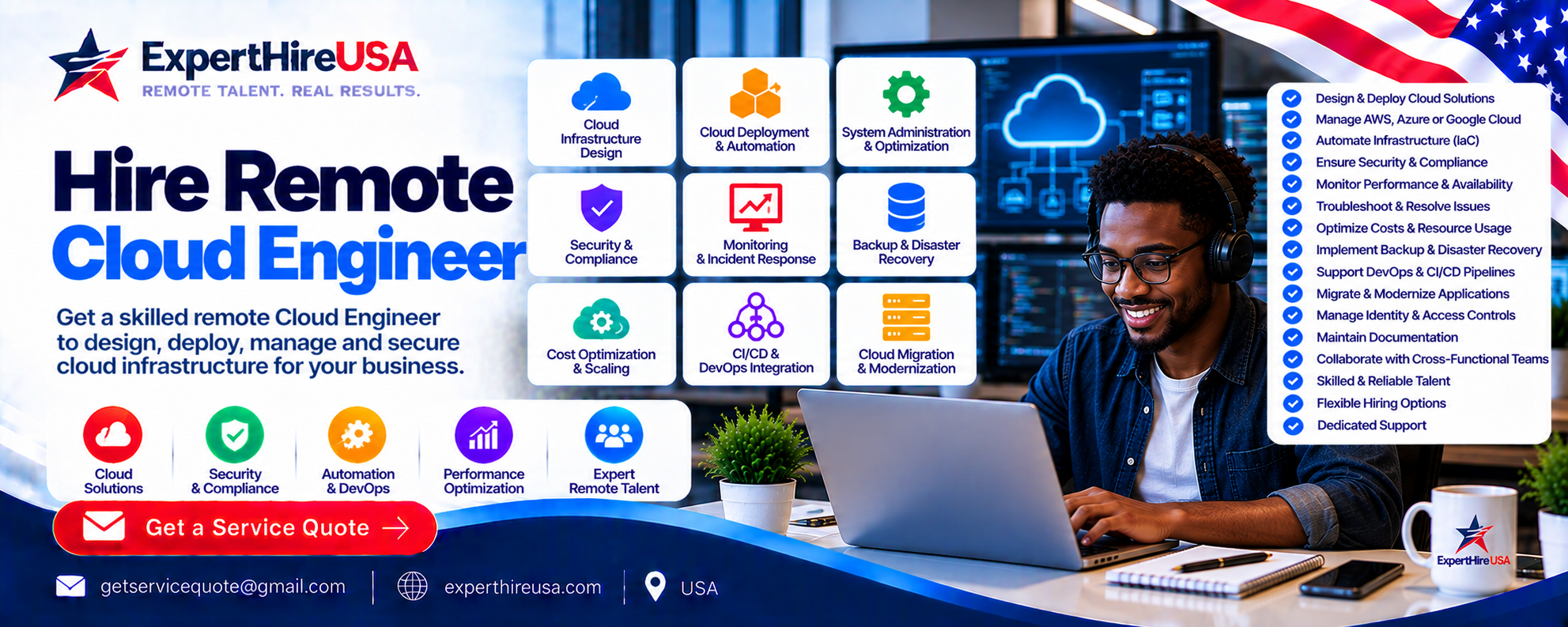
Hire Remote Cloud Engineer
Businesses building, migrating, scaling or maintaining cloud infrastructure can hire a Remote Cloud Engineer to design, deploy, automate, secure and manage cloud environments across Amazon Web Services, Microsoft Azure, Google Cloud Platform and hybrid infrastructure. A skilled Cloud Engineer helps organizations create reliable infrastructure for websites, SaaS platforms, APIs, databases, enterprise applications, data platforms, development environments and distributed systems while improving deployment consistency, scalability, monitoring and operational efficiency. We help businesses hire Remote Cloud Engineers supporting organizations across the USA, United Kingdom, Australia, UAE and Dubai. Remote cloud professionals can work with startups, SaaS companies, software development companies, e-commerce businesses, financial technology organizations, healthcare technology businesses, enterprises, digital agencies, data companies, AI businesses and organizations modernizing traditional IT infrastructure.
Depending on the technology stack and responsibilities, businesses may hire professionals under related titles such as AWS Cloud Engineer, Azure Cloud Engineer, Google Cloud Engineer, Cloud Infrastructure Engineer, Cloud Platform Engineer, Cloud DevOps Engineer, Cloud Operations Engineer, Cloud Security Engineer, Cloud Automation Engineer, Cloud Migration Engineer, Site Reliability Engineer, Infrastructure Engineer, Kubernetes Engineer or Cloud Solutions Engineer. Some professionals specialize deeply in one cloud provider, while others manage multi-cloud or hybrid environments. Businesses should therefore match engineers according to their actual infrastructure, applications, compliance requirements, expected traffic, deployment architecture and internal development capabilities rather than treating all cloud engineering experience as interchangeable.
What Does a Remote Cloud Engineer Do?
A Remote Cloud Engineer designs and manages the technical infrastructure that allows applications and business systems to operate in cloud environments. Responsibilities can begin with cloud architecture and environment setup, including networks, compute resources, storage, databases, identity controls, load balancing, DNS, monitoring and backup systems. The engineer may create separate development, staging and production environments and establish controlled methods for deploying changes between them. Rather than configuring every resource manually, experienced Cloud Engineers frequently use Infrastructure as Code to create repeatable environments that can be reviewed, version controlled and reproduced when required. This approach can reduce configuration drift and make infrastructure changes easier to document and audit.
Cloud Engineers also support ongoing operations. They can monitor infrastructure performance, investigate alerts, troubleshoot deployment failures, review resource utilization, maintain backups, coordinate disaster-recovery procedures and help development teams deploy applications reliably. Engineers may configure autoscaling, container environments, serverless functions, managed databases, object storage, content delivery networks, queues, caching and other cloud services according to application requirements. They can also assist with cloud migrations by assessing existing infrastructure, planning migration stages, creating target environments, moving workloads and validating systems after migration. Production changes should follow appropriate testing, approval and rollback procedures, particularly when infrastructure supports business-critical or customer-facing services.
Why Hire a Remote Cloud Engineer for Your Business?
Cloud platforms make infrastructure easier to provision, but they do not automatically make infrastructure reliable, secure or cost-efficient. Organizations can create servers and databases quickly, yet poorly designed cloud environments may develop unnecessary costs, inconsistent configurations, excessive permissions and operational risks. Hiring a Remote Cloud Engineer gives the business dedicated technical expertise for designing and maintaining infrastructure according to actual application requirements. Startups can establish scalable infrastructure without building a large internal infrastructure department, while established organizations can add specialized AWS, Azure, Google Cloud, Kubernetes or DevOps expertise to existing engineering teams.
Remote Cloud Engineers can also support organizations moving away from manually managed servers and deployments. Infrastructure as Code, automated CI/CD pipelines, containerization and centralized monitoring can make software delivery more repeatable and provide engineering teams with better visibility into production systems. Cloud Engineers can work alongside Back-End Developers, Front-End Developers, DevOps Engineers, Data Engineers, Security Engineers and Software Architects to create an infrastructure layer that supports the wider technology organization. Companies with international development teams can hire cloud professionals supporting operations across the USA, UK, Australia, UAE and Dubai and can organize appropriate coverage for systems serving customers in several regions.
AWS, Azure, Google Cloud, DevOps and Cloud Engineering Skills to Look For
Amazon Web Services Cloud Engineers may work with services such as EC2, S3, RDS, Aurora, DynamoDB, Lambda, ECS, EKS, Elastic Load Balancing, Auto Scaling, CloudFront, Route 53, VPC, IAM, CloudWatch, CloudTrail, SQS, SNS, API Gateway, Secrets Manager and other AWS services. Microsoft Azure Cloud Engineers may work with Azure Virtual Machines, App Service, Azure Functions, Azure SQL Database, Azure Storage, Virtual Networks, Microsoft Entra ID, Azure Kubernetes Service, Azure Monitor, Application Insights, Key Vault, Azure DevOps and related services. Google Cloud Engineers may work with Compute Engine, Cloud Run, Cloud Functions, Google Kubernetes Engine, Cloud Storage, Cloud SQL, BigQuery, VPC, IAM, Cloud Monitoring and other GCP technologies. Engineers should understand the services relevant to the organization’s architecture rather than simply having broad familiarity with a cloud provider.
Modern Cloud Engineers may also work with Terraform, OpenTofu, AWS CloudFormation, Azure Bicep, Ansible and other Infrastructure as Code or configuration-management technologies. Container environments can involve Docker and Kubernetes, while CI/CD workflows may use GitHub Actions, GitLab CI/CD, Jenkins, Azure DevOps, CircleCI or similar platforms. Monitoring and observability can involve Prometheus, Grafana, Datadog, New Relic, Elastic, Splunk or native cloud monitoring services. Engineers may work with Linux, Bash, PowerShell, Python, Go or other scripting languages for infrastructure automation. Strong candidates should also understand networking concepts such as DNS, TCP/IP, subnets, routing, VPNs, firewalls, proxies, load balancers and TLS because many cloud incidents ultimately involve interactions between infrastructure, networking, identity and applications.
Remote Cloud Engineer Services for Different Businesses and Industries
SaaS and software companies can hire Remote Cloud Engineers to build application infrastructure, deployment pipelines, container platforms, databases, monitoring systems and development environments. E-commerce businesses can use cloud professionals to support scalable storefront infrastructure, APIs, databases, caching, content delivery and integrations during periods of changing traffic. AI and machine learning businesses can hire cloud engineers to support data pipelines, model-serving infrastructure, GPU workloads and scalable application environments alongside specialized ML Engineers and Data Engineers. Digital agencies and software development companies can use Cloud Engineers to maintain infrastructure for multiple applications or customer projects while keeping client environments appropriately separated.
Fintech, financial services and insurance technology organizations can use Cloud Engineers to build infrastructure under appropriate security and compliance controls, while healthcare technology organizations may require additional safeguards around sensitive health information. Logistics, telecommunications, media, education, real estate and enterprise businesses can use cloud professionals for migrations, application modernization, disaster recovery, infrastructure automation and platform operations. Larger organizations may build cloud teams containing Cloud Engineers, DevOps Engineers, Site Reliability Engineers, Cloud Architects, Platform Engineers, Network Engineers, Cloud Security Engineers, Database Administrators and FinOps Specialists, allowing infrastructure responsibilities to be divided according to expertise and operational requirements.
Areas We Serve: Hire Remote Cloud Engineers in the USA, UK, Australia, UAE and Dubai
Businesses looking to hire a Remote Cloud Engineer in the USA can find professionals supporting organizations throughout California, New York, Texas, Florida, Illinois, Pennsylvania, New Jersey, Georgia, North Carolina, Virginia, Washington, Massachusetts, Colorado, Arizona, Ohio, Michigan, Tennessee, Maryland, Minnesota, Missouri, Wisconsin, Indiana, Connecticut, Oregon, Utah, Nevada and other states. Technology companies in San Francisco, Silicon Valley, New York City, Los Angeles, Seattle, Austin, Dallas, Houston, Chicago, Miami, Atlanta, Boston, Denver, Phoenix, Philadelphia, San Diego, Charlotte and other technology and business centers can hire remote professionals for cloud infrastructure and operations. Relevant searches include Hire Remote Cloud Engineer USA, AWS Cloud Engineer USA, Azure Cloud Engineer USA, Google Cloud Engineer USA, Remote DevOps Cloud Engineer USA, Kubernetes Engineer USA, Cloud Infrastructure Engineer USA and Cloud Migration Engineer USA.
Businesses in the United Kingdom can hire Remote Cloud Engineers supporting organizations throughout England, Scotland, Wales and Northern Ireland, including London, Manchester, Birmingham, Leeds, Liverpool, Bristol, Cambridge, Edinburgh, Glasgow, Cardiff and Belfast. Australian companies can hire cloud professionals supporting New South Wales, Victoria, Queensland, Western Australia, South Australia, Tasmania, Australian Capital Territory and Northern Territory, including Sydney, Melbourne, Brisbane, Perth, Adelaide, Canberra, Gold Coast, Hobart and Darwin. UAE organizations can hire Remote Cloud Engineers supporting Dubai, Abu Dhabi, Sharjah, Ajman, Ras Al Khaimah, Fujairah and Umm Al Quwain. Companies operating from Dubai Internet City, Dubai Silicon Oasis, DIFC, Business Bay, Downtown Dubai, Dubai Media City, Jumeirah Lakes Towers and other commercial and technology districts can hire cloud professionals supporting local, regional and global infrastructure.
Why Businesses Should Trust Us When Hiring Remote Cloud Engineers
Cloud engineering requires technology-specific matching because an engineer who specializes in AWS serverless architecture may not be the best fit for an organization running Azure Kubernetes Service and Microsoft enterprise systems. Our approach focuses on identifying Remote Cloud Engineers according to cloud provider, infrastructure architecture, application stack, operating systems, container environment, Infrastructure as Code tools, CI/CD requirements, databases, security requirements and expected responsibilities. Businesses can hire AWS Cloud Engineers, Microsoft Azure Cloud Engineers, Google Cloud Engineers, Kubernetes specialists, cloud migration professionals or engineers experienced with multi-cloud and hybrid environments according to the technical requirements of the project.
Infrastructure access also requires strong security controls because cloud administrative privileges can affect production applications, customer data and business continuity. Engineers should use named organization-controlled accounts, role-based permissions, multi-factor authentication, centralized identity management and approved secrets-management systems. Long-lived credentials should be minimized where appropriate, and passwords, API keys and production secrets should not be stored in source-code repositories or unsecured documents. Infrastructure changes should be version controlled where practical, peer reviewed according to risk, tested before production deployment and supported by rollback procedures. Logging, monitoring, backup verification and incident-response procedures should also be defined. No Cloud Engineer can guarantee that infrastructure will never experience downtime or security incidents, but disciplined engineering and operational controls can reduce avoidable risks and improve recovery capabilities. Businesses can hire Remote Cloud Engineers supporting cloud projects and ongoing infrastructure across the USA, UK, Australia, UAE and Dubai.
Frequently Asked Questions About Hiring a Remote Cloud Engineer
What is a Remote Cloud Engineer? A Remote Cloud Engineer is an infrastructure professional who designs, deploys, automates, monitors and maintains cloud computing environments while working remotely.
What does a Cloud Engineer do? Cloud Engineers can manage servers, networks, storage, databases, identity systems, containers, monitoring, backups, Infrastructure as Code, CI/CD pipelines and other cloud infrastructure components.
Can I hire an AWS Cloud Engineer remotely? Yes. Businesses can hire Remote AWS Cloud Engineers experienced with Amazon Web Services infrastructure, deployment, automation and operations.
Can I hire a Microsoft Azure Cloud Engineer? Yes. Azure Cloud Engineers can support Azure infrastructure, networking, identity, compute, databases, Kubernetes, monitoring and automation.
Can I hire a Google Cloud Engineer? Yes. Businesses using Google Cloud Platform can hire engineers experienced with GCP infrastructure, Cloud Run, GKE, Compute Engine, Cloud SQL, BigQuery and related services.
Can I hire a Kubernetes Engineer remotely? Yes. Kubernetes infrastructure can be managed remotely, and businesses can hire specialists experienced with EKS, AKS, GKE or self-managed Kubernetes environments.
Can a Cloud Engineer use Terraform? Yes. Terraform is widely used for Infrastructure as Code, and businesses can specifically hire Remote Terraform Engineers for automated cloud provisioning.
Can Cloud Engineers work with Docker? Yes. Docker and containerized application deployment are common parts of modern cloud engineering.
Can a Cloud Engineer create CI/CD pipelines? Yes. Depending on experience, Cloud Engineers can build and maintain deployment pipelines using GitHub Actions, GitLab CI/CD, Jenkins, Azure DevOps and other tools.
Can a Cloud Engineer migrate applications to the cloud? Yes. Cloud Migration Engineers can assess existing infrastructure, design target environments, coordinate migration stages and validate workloads after migration.
Can a Cloud Engineer manage cloud security? Cloud Engineers can implement infrastructure security controls such as IAM, network restrictions, encryption configurations, secrets management and logging. Complex security architecture, compliance and incident response may also involve dedicated Cloud Security professionals.
Can a Cloud Engineer help reduce AWS, Azure or GCP costs? Yes. Engineers can review resource utilization, unused infrastructure, scaling configurations, storage and architecture to identify potential optimization opportunities. Cost reductions depend on actual workload and business requirements.
What is the difference between a Cloud Engineer and a DevOps Engineer? Cloud Engineers generally focus on cloud infrastructure, while DevOps Engineers often concentrate more broadly on software delivery, CI/CD, automation and collaboration between development and operations. The roles frequently overlap.
What is the difference between a Cloud Engineer and a Cloud Architect? Cloud Architects generally focus more heavily on high-level architecture and technical design, while Cloud Engineers typically implement and operate the infrastructure. Senior engineers may perform both functions.
What is the difference between a Cloud Engineer and a Site Reliability Engineer? Site Reliability Engineers focus heavily on production reliability, observability, incident response and engineering practices around service availability, while Cloud Engineers typically have broader infrastructure responsibilities.
Can startups hire Remote Cloud Engineers? Yes. Startups can hire remote professionals to establish cloud architecture, automated deployments, monitoring and scalable infrastructure without requiring an entire internal infrastructure department.
Can I hire a Remote Cloud Engineer in the USA? Yes. Businesses throughout the United States can hire AWS, Azure, Google Cloud, Kubernetes and infrastructure engineers remotely.
Can I hire a Remote Cloud Engineer in the UK? Yes. Organizations throughout England, Scotland, Wales and Northern Ireland can hire Remote Cloud Engineers.
Can I hire a Remote Cloud Engineer in Australia? Yes. Companies in Sydney, Melbourne, Brisbane, Perth, Adelaide, Canberra and throughout Australia can hire remote cloud professionals.
Can I hire a Remote Cloud Engineer in Dubai or the UAE? Yes. Businesses in Dubai, Abu Dhabi, Sharjah and throughout the UAE can hire Remote Cloud Engineers for AWS, Azure, GCP and hybrid infrastructure.
Why should I hire a Remote Cloud Engineer through your service? Our approach focuses on matching Cloud Engineers with your cloud provider, architecture, applications, Infrastructure as Code, DevOps tools, security requirements and technical environment. Businesses can hire individual engineers or build remote cloud teams supporting infrastructure across the USA, UK, Australia, UAE and Dubai.
Why Should Businesses Trust Us When Hiring Remote Experts and Specialists?

Trust is essential when hiring professionals who will handle important business responsibilities, communicate with customers, access company systems, or contribute to ongoing projects. Our approach is focused on helping businesses hire experts and specialists with the skills and experience appropriate for their individual requirements. We understand that businesses are not simply looking for another worker; they are looking for dependable professionals who can become productive members of their teams.
We support businesses searching for remote professionals across administration, accounting, bookkeeping, customer service, sales, digital marketing, IT, software development, data, healthcare administration, legal support, insurance, real estate, e-commerce, research, and many other professional areas. This broad selection allows companies to look for talent according to the actual responsibilities of the position rather than relying on a one-size-fits-all hiring approach.
Our focus is also on flexibility. Businesses may need a full-time professional, part-time specialist, dedicated remote worker, or expert for a specific project. We help organizations explore talent according to those requirements.
Clear communication is equally important. Before hiring, businesses should understand the role being filled, required skills, expected responsibilities, working arrangements, and other important requirements. This helps create clearer expectations between businesses and remote professionals.
Whether you are hiring your first virtual assistant or expanding an established remote department, our objective remains the same: help you find skilled people who can support your organization effectively.
When you hire experts through our remote hiring solutions, you gain access to professionals across multiple fields while maintaining the flexibility to build a workforce around your organization’s specific needs.
What Areas and Countries Do You Serve for Remote Hiring?
Our remote hiring solutions are designed for businesses looking for professional talent across international markets. We help companies hire experts, hire specialists, and find remote workers for positions that can be successfully performed online, regardless of where the business maintains its primary office.
We serve businesses throughout the United States, including companies in major commercial markets such as New York, California, Texas, Florida, Illinois, Washington, Massachusetts, Georgia, Arizona, Colorado, and other states. American businesses can find remote professionals for administrative, accounting, customer service, sales, marketing, technology, healthcare support, legal, real estate, and e-commerce positions.
We also support businesses throughout the United Kingdom, including London, Manchester, Birmingham, Leeds, Liverpool, Bristol, Glasgow, Edinburgh, and other locations. UK companies can hire specialists for both everyday operational responsibilities and more specialized professional functions.
Our services extend throughout Australia, supporting organizations in Sydney, Melbourne, Brisbane, Perth, Adelaide, Canberra, Gold Coast, Newcastle, and other Australian locations.
Businesses in Dubai and throughout the United Arab Emirates (UAE) can also use our remote hiring solutions. We support organizations in Dubai, Abu Dhabi, Sharjah, Ajman, Ras Al Khaimah, Fujairah, and Umm Al Quwain that want to expand their teams with remote professionals.
Because the positions we focus on are remote-compatible, geographical distance does not have to prevent businesses from accessing specialized skills. Whether your organization operates from the USA, UK, Australia, Dubai, or elsewhere in the UAE, you can search for professionals according to your role requirements.
Our objective is to make international remote hiring more accessible, allowing businesses to build flexible teams and access expertise beyond their immediate local employment market.
What Types of Experts and Specialists Can Businesses Hire Through Us?
Businesses can hire experts and specialists across a wide range of remote-compatible professional categories. Our focus is on helping organizations find talent for both everyday business operations and positions requiring more specialized knowledge, experience, or technical capabilities.
For administrative requirements, businesses can hire virtual assistants, executive assistants, administrative assistants, remote receptionists, appointment setters, scheduling coordinators, data entry specialists, and other administrative professionals. Accounting and finance requirements can be supported by bookkeepers, accountants, accounts payable specialists, accounts receivable specialists, payroll professionals, billing specialists, and financial analysts.
Companies looking to strengthen customer acquisition and customer relationships can hire customer service representatives, live chat specialists, email support specialists, sales representatives, sales development representatives, business development representatives, lead generation specialists, account managers, and customer success professionals.
Digital and creative roles include SEO specialists, PPC specialists, digital marketers, social media managers, content writers, copywriters, graphic designers, presentation designers, video editors, and content marketing professionals. Technology-focused businesses can search for web developers, software developers, IT support specialists, database administrators, data analysts, automation specialists, AI professionals, and other technical experts.
We also support more specialized industries. Businesses can find remote professionals for healthcare administration, medical billing, medical coding, insurance verification, legal support, paralegal services, insurance operations, real estate administration, property management, mortgage processing, e-commerce operations, logistics, recruitment, research, and related functions.
This variety enables businesses in the USA, UK, Australia, Dubai, and the UAE to build remote teams around their actual operational requirements.
Whether you need one specialist or professionals across several departments, our goal is to provide a straightforward way to identify the expertise your business needs and hire remote talent capable of supporting your organization.
Why Should Companies in the USA, UK, Australia, Dubai, and UAE Hire Remote Specialists?
-
Remote hiring gives businesses greater flexibility when searching for professionals with specific skills. Companies in the USA, UK, Australia, Dubai, and across the UAE are no longer limited to recruiting only candidates who live within commuting distance of their offices. Instead, they can search for remote experts according to experience, professional capabilities, industry knowledge, and the requirements of each position.
One major advantage is access to a broader talent pool. A company searching locally may have difficulty finding someone with experience in a particular technology, software platform, industry, or business process. Remote hiring expands the search and can make it easier to find professionals with the required specialization.
Remote teams can also provide greater workforce flexibility. Businesses may hire specialists for full-time responsibilities, part-time support, dedicated ongoing positions, or individual projects. This allows organizations to structure their teams according to workloads and changing operational requirements.
Companies can use remote professionals to support numerous departments. A business might hire a virtual assistant for administration, a bookkeeper for financial records, a customer service representative for customer communication, a lead generation specialist for sales development, and an SEO specialist for online visibility. More specialized organizations may require medical billing specialists, paralegals, insurance professionals, software developers, data analysts, or e-commerce specialists.
Remote hiring can be particularly valuable for growing companies that need additional expertise without building every function around a traditional office-based workforce.
Our goal is to help organizations hire experts and specialists who complement their existing teams and provide the skills needed for important business functions. Whether your company operates in New York, London, Sydney, Dubai, Abu Dhabi, or another market, remote hiring provides a flexible way to access professional talent and develop a workforce capable of supporting long-term business growth.
How Do You Help Businesses Find the Right Experts and Specialists?
Finding the right professional involves more than simply matching a business with someone who has a particular job title. Companies need professionals whose skills, experience, availability, and working capabilities align with the responsibilities of the position. Our approach helps businesses hire experts and specialists based on their specific staffing and operational requirements.
The process begins with understanding what type of professional the business needs. Some companies may require a virtual assistant to manage administrative responsibilities, while others need a bookkeeper, customer service representative, sales specialist, digital marketer, software developer, or industry-specific professional. Clearly defining the role helps narrow the search toward suitable remote talent.
Businesses can hire professionals across administration, accounting, finance, customer support, sales, marketing, design, technology, data, human resources, healthcare administration, legal support, insurance, real estate, e-commerce, logistics, and research. This broad selection makes it possible to find specialists for both general business functions and more specialized positions.
We also recognize that staffing requirements vary between organizations. A startup may require one versatile remote professional, while an established company may need several specialists supporting different departments. Businesses can therefore explore talent for full-time, part-time, dedicated, ongoing, or project-based requirements.
Our remote hiring solutions serve organizations throughout the USA, UK, Australia, Dubai, and the UAE, helping companies access professionals beyond their immediate geographic areas.
The objective is straightforward: make it easier to identify the expertise your organization requires and connect with professionals capable of performing that work remotely. Whether you need one expert for a specific responsibility or multiple specialists to expand your workforce, we help you build a remote team around your business needs.
Can Small Businesses and Startups Hire Experts and Specialists Through Your Service?
Yes. Our remote hiring solutions are suitable for small businesses, startups, entrepreneurs, agencies, growing companies, and established organizations that need access to professional skills. Small businesses often have important responsibilities that require specialized expertise but may not need to establish a large traditional in-house department for every function.
For example, a growing company might need a bookkeeper to maintain financial records, a virtual assistant to manage administrative responsibilities, a customer service representative to respond to customers, and a digital marketing specialist to support online growth. Remote hiring allows businesses to access these skills while building their teams according to their current requirements.
Startups can also hire experts for specialized areas such as software development, web development, graphic design, lead generation, SEO, social media management, data analysis, automation, recruitment, and project management. This provides access to different professional capabilities as the company develops.
Flexible staffing is particularly useful when business requirements change. Organizations may need a specialist for a particular project, part-time support for an existing department, or a dedicated professional to handle ongoing responsibilities. As workloads increase, additional remote workers can be introduced into different areas of the business.
We support companies operating throughout the United States, United Kingdom, Australia, Dubai, and the wider UAE, including businesses that work entirely online or maintain a combination of office-based and remote teams.
Our goal is to make professional talent accessible to organizations of different sizes. You do not need to be a large corporation to hire specialists with relevant expertise. Whether you are launching a new company, expanding an existing operation, or strengthening a particular department, remote professionals can provide the skills and additional capacity required to support continued business growth.
Can We Hire Experts and Specialists for Full-Time, Part-Time, or Project-Based Work?
Yes. Businesses have different staffing requirements, which is why flexibility is an important part of remote hiring. Companies can hire experts and specialists according to the type of support they require, including full-time, part-time, dedicated, ongoing, or project-based arrangements.
A full-time remote professional may be appropriate when a business has consistent responsibilities that require daily attention. Examples include virtual assistants, executive assistants, bookkeepers, customer service representatives, sales representatives, account managers, developers, and other professionals who can become an ongoing part of business operations.
Part-time hiring may be more appropriate when a company needs regular support but does not require a professional for a complete working day. This can work well for bookkeeping, administrative support, social media management, research, data entry, customer support, and numerous other functions.
Businesses can also hire specialists for defined projects. A company might require a web developer to complete a website, a graphic designer for marketing materials, a data analyst for a reporting project, an automation specialist to develop workflows, or a researcher for a specific business initiative.
Dedicated remote professionals can provide another option for organizations that want consistent access to particular expertise and closer integration with their existing teams.
These hiring possibilities are available to companies throughout the USA, UK, Australia, Dubai, and UAE. Businesses can determine the role, responsibilities, required experience, expected working schedule, and duration according to their operational needs.
This flexibility allows organizations to build remote teams without applying the same staffing structure to every position. Whether you need temporary expertise, ongoing assistance, or a long-term team member, you can hire remote experts and specialists according to the requirements of your business.
Which Businesses and Industries Can Hire Remote Experts and Specialists Through You?
Our remote hiring solutions can support businesses across a broad range of industries because many administrative, financial, technical, customer-facing, and professional responsibilities can now be completed remotely. We help organizations hire experts and specialists according to their industry, business model, department, and individual role requirements.
Professional services companies can hire accountants, bookkeepers, administrative assistants, executive assistants, researchers, customer support representatives, and marketing professionals. Technology companies can find software developers, web developers, IT support specialists, data analysts, QA professionals, automation specialists, and digital marketers.
Healthcare organizations can hire remote professionals for medical administration, billing, coding, patient scheduling, insurance verification, prior authorization, medical records, and other non-clinical support functions. Legal businesses can find paralegals, legal assistants, legal researchers, intake specialists, document review professionals, and other remote legal support specialists.
Real estate and property businesses can hire real estate virtual assistants, transaction coordinators, property listing specialists, lead generation professionals, appointment setters, mortgage support professionals, and property management assistants. E-commerce companies can hire Amazon virtual assistants, Shopify specialists, product listing professionals, customer service representatives, order processing specialists, and e-commerce operations professionals.
We also support businesses in insurance, logistics, education, recruitment, marketing, finance, consulting, hospitality, nonprofit organizations, and numerous other sectors.
Our services are designed for businesses throughout the USA, UK, Australia, Dubai, and the UAE, from startups and small businesses to agencies and established organizations.
Every company has different staffing requirements. Our objective is to provide access to a broad range of remote talent so businesses can find professionals whose expertise corresponds with the work they need completed.
Whether you need administrative support or highly specialized professional skills, you can hire experts and specialists to strengthen individual departments, increase operational capacity, and build a flexible remote workforce.
- Hire Experts
- Hire Remote Account Manager
- Hire Remote Customs Administrator
- Hire Remote Medical Virtual Assistant
- Hire Remote Payroll Specialist
- Hire Remote Transaction Coordinator
- Hire Remote Property Management Virtual Assistant
- Hire Remote Translator
- Hire Remote Transcriptionist
- Hire Remote Research Analyst
- Hire Remote Research Assistant
- Hire Remote Shopify Virtual Assistant
- Hire Remote Amazon Virtual Assistant
- Hire Remote E Commerce Virtual Assistant
- Hire Remote Legal Intake Specialist
- Hire Remote Intake Specialist
- Hire Remote Legal Assistant
- Hire Remote Medical Coder
- Hire Remote Medical Billing Specialist
- Hire Remote Scrum Master
- Hire Remote Product Manager
- Hire Remote Business Analyst
- Hire Remote Talent Acquisition Specialist
- Hire Remote Hr Specialist
- Hire Remote Recruiter
- Hire Remote AI Automation Specialist
- Hire Remote Automation Specialist
- Hire Remote Power BI Developer
- Hire Remote Business Intelligence Analyst
- Hire Remote Machine Learning Engineer
- Hire Remote AI Engineer
- Hire Remote Data Engineer
- Hire Remote Data Scientist
- Hire Remote Cloud Engineer
- Hire Remote Devops Engineer
- Hire Remote Cybersecurity Specialist
- Hire Remote System Administrator
- Hire Remote Technical Support Specialist
- Hire Remote IT Support Specialist
- Hire Remote Mobile App Developer
- Hire Remote Shopify Developer
- Hire Remote WordPress Developer
- Hire Remote Back End Developer
- Hire Remote Front End Developer
- Hire Remote Full Stack Developer
- Hire Remote Software Developer
- Hire Remote Web Developer
- Hire Remote Web Designer
- Hire Remote Video Editor
- Hire Remote Graphic Designer
- Hire Remote Content Writer
- Hire Remote Email Marketing Specialist
- Hire Remote Google Ads Specialist
- Hire Remote PPC Specialist
- Hire Remote Digital Marketing Specialist
- Hire Remote Account Executive
- Hire Remote Cold Calling Specialist
- Hire Remote Inside Sales Representative
- Hire Remote Appointment Setter
- Hire Remote Customer Success Manager
- Hire Remote Customer Service Representative
- Hire Remote Administrative Assistant
- Hire Remote Virtual Assistant
- Hire Remote Executive Assistant
- Hire Remote Wellness Program Coordinator
- Hire Remote Vendor Coordinator
- Hire Remote Underwriting Specialist
- Hire Remote Studio Manager
- Hire Remote Student Admissions Coordinator
- Hire Remote Social Media Specialist
- Hire Remote Social Media Manager
- Hire Remote Social Media Content Creator
- Hire Remote Shipping Documentation Coordinator
- Hire Remote SEO Specialist
- Hire Remote School Administrator
- Hire Remote Schedule Manager
- Hire Remote Sales Representative
- Hire Remote Sales Operations Manager
- Hire Remote Sales Development Representative
- Hire Remote Route Coordinator
- Hire Remote Risk Assessment Support
- Hire Remote Reservation Specialist
- Hire Remote Reporting Specialist
- Hire Remote Renewals Coordinator
- Hire Remote Receptionist
- Hire Remote Recall Coordinator
- Hire Remote Real Estate Coordinator
- Hire Remote Real Estate Analyst
- Hire Remote Quote Generation Specialist
- Hire Remote QA Analyst
- Hire Experts
- businesses
- Hire Remote Publishing Editor
- Hire Remote Publishing Coordinator
- Hire Remote Property Listing Specialist
- Hire Remote Project Manager
- Hire Remote Project Documentation Specialist
- Hire Remote Project Coordinator
- Hire Remote Production Coordinator
- Hire Remote Production Artist
- Hire Remote Product Marketing Manager
- Hire Remote Product Analyst
- Hire Remote Presentation Designer
- Hire Remote Pre Authorization Specialist
- Hire Remote Portfolio Manager
- Hire Remote Policy Admin Specialist
- Hire Remote Pinterest Specialist
- Hire Remote Permit Specialist
- Hire Remote Patient Scheduling Coordinator
- Hire Remote Patient Reactivation Specialist
- Hire Remote Patient Liaison
- Hire Remote Patient Care Coordinator
- Hire Remote Partnership Coordinator
- Hire Remote Paraplanner
- Hire Remote Paralegal
- Hire Remote Paid Ads Specialist
- Hire Remote Operations Manager
- Hire Remote Online Travel Platform Manager
- Hire Remote Online Grader
- Hire Remote Mortgage Paraplanner
- Hire Remote Medical Records Specialist
- Hire Remote Media Buyer
- Hire Remote Marketing Manager
- Hire Remote Market Research Analyst
- Hire Remote Loan Processor
- Hire Remote LMS Administrator
- Hire Remote Legal Researcher
- Hire Remote Learning Designer
- Hire Remote Lead Generation Specialist
- Hire Remote Lead Follow Up Coordinator
- Hire Remote L&D Coordinator
- Hire Remote KYC AML Specialist
- Hire Remote Investor Relations Specialist
- Hire Remote Insurance Verification Specialist
- Hire Remote Guest Relations Coordinator
- Hire Remote Grant Writer
- Hire Remote Fundraising Coordinator
- businesses
- Hire Experts
- Hire Remote Formatting Specialist
- Hire Remote Fleet Administrator
- Hire Remote Financial Planner
- Hire Remote Family Support Specialist
- Hire Remote Executive Coordinator
- Hire Remote Event Coordinator
- Hire Remote Email Marketing Coordinator
- Hire Remote E Commerce Specialist
- Hire Remote Due Diligence Specialist
- Hire Remote Donor Database Specialist
- Hire Remote Document Analyst
- Hire Remote Dispatch Coordinator
- Hire Remote Digital Asset Manager
- Hire Remote Database Administrator
- Hire Remote Data Entry Specialist
- Hire Remote Data Analyst
- Hire Remote Customer Support Specialist
- Hire Remote Customer Insights Analyst
- Hire Remote Course Platform Specialist
- Hire Remote Copywriter
- Hire Remote Conversation Designer
- Hire Remote Content Strategist
- Hire Remote Content Scheduler
- Hire Remote Content Coordinator
- Hire Remote Concierge
- Hire Remote Community Manager
- Hire Remote Communications Specialist
- Hire Remote Client Reporting Specialist
- Hire Remote Client Onboarding Specialist
- Hire Remote Client Experience Manager
- Hire Remote Claims Processing Specialist
- Hire Remote Chief Of Staff
- Hire Remote Catering Sales Coordinator
- Hire Remote Campaign Coordinator
- Hire Remote Business Development Representative
- Hire Remote Broker Support Specialist
- Hire Remote Bookkeeper
- Hire Remote Booking Coordinator
- Hire Remote Book Of Business Manager
- Hire Remote ASO Specialist
- Hire Remote Artist Manager
- Hire Remote Application Reviewer
- Hire Remote Amazon FBA Specialist
- Hire Remote After Hours Support Representative
- Hire Remote Administrative Coordinator
- businesses
- Hire Remote Accountant
- Hire Experts